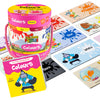

Simple toys like blocks and puzzles build the core spatial and logic skills children need for future success in science, technology, engineering, and math. It's easy to overlook a plain puzzle box or a set of wooden blocks sitting quietly on a shelf — but a surprising amount of early engineering and math thinking is happening every time a child picks one up.
Why Blocks Matter
Early Engineering Stacking and balancing teach kids about gravity, symmetry, and weight distribution. Long before a child hears the word "engineering," they're already testing it — figuring out why a tower topples when it's uneven, or why a wide base holds steadier than a narrow one.
Math Skills Building helps children understand measurement, equality, and spatial dimensions. Comparing block sizes, counting how many fit in a row, or noticing that two small blocks equal one big one are all early, hands-on math concepts — long before numbers on a page mean much to them.
Fine Motor Control Picking up and placing pieces strengthens hand-eye coordination. This might be the most underrated benefit of all — the same small muscle control built by stacking blocks is what later makes holding a pencil and writing far more comfortable.
It Doesn't Have to Be Store-Bought
It's worth saying plainly: none of this requires expensive kits or coding robots. Some of the richest STEM moments come from the simplest household objects — a stack of empty boxes, a few plastic bottles, spare buttons, a length of string. Without fixed instructions telling a child exactly what to build, these open-ended materials push them to plan, test, and rebuild on their own — which is really the whole point.
What actually matters isn't the price tag or the brand on the box. It's whether the toy or object invites a child to keep exploring, get something wrong, and try again.
For families who want a bit more structure alongside this free-form play, our 365 Science Experiments Book (often known as the Big Book of Science Experiments) gives a hands-on experiment for every day of the year — covering sound, light, gravity, magnetism, and chemical reactions, with clear step-by-step instructions and difficulty icons so parents know exactly what supervision each one needs.
Why Puzzles Matter
Critical Thinking Puzzles train the brain to recognize patterns and test different solutions. A child scanning for the right piece is doing quiet, repeated pattern-matching — a skill that carries directly into later math and science reasoning.
Patience and Focus Children learn resilience by working through a challenge until the pieces fit. A puzzle doesn't reward giving up halfway — it teaches, gently and without any lecture, that sticking with something difficult eventually pays off.
Logical Reasoning Trial and error helps kids form hypotheses and adjust their strategies. Every "let me try this piece instead" is a tiny scientific method in action — guess, test, adjust, try again.
The Same Pride Adults Feel, Just Smaller
There's a particular feeling adults know well — the one that comes from fixing something yourself. A father who repairs his own car, even something as small as a loose belt or a dead battery, often walks away feeling like he's outsmarted the mechanic entirely, even if a professional could have done it in ten minutes. That feeling isn't really about the car. It's about having solved something with your own hands, start to finish, without anyone stepping in.
Kids get that exact same rush from finishing a puzzle or getting a wobbly block tower to finally stand. The scale is smaller, but the feeling is identical — a genuine, home-grown sense of "I did that myself." That sense of accomplishment is worth as much as any of the specific skills involved, because it's what makes a child want to pick up the next challenge instead of avoiding it.
Making the Most of Playtime
A few simple ways to get more out of block and puzzle time at home:
- Ask, don't answer. A simple "what do you think will happen if we add one more block?" does more for their thinking than stepping in to fix a wobbly tower yourself.
- Let them struggle a little before helping. The moment of figuring it out on their own is where most of the learning actually happens.
- Start with age-appropriate piece counts. A puzzle that's too advanced creates frustration instead of the patience it's meant to build — sizing it right matters more than the theme.
- Talk through their thinking. Asking "why do you think that piece doesn't fit?" turns quiet play into active reasoning.
- Rotate toys instead of buying more. A block set or puzzle put away for a few weeks often comes back to a child feeling brand new.
Building the Right Skills at the Right Stage
Puzzles work best when they match a child's current stage rather than pushing too far ahead too soon. For younger children just starting out, our My First Puzzle collection keeps piece counts low and shapes simple. As kids grow more confident, Easy Peasy Puzzles offers a gentle step up, and our Bright Brain range is built specifically around logic and focus-building for kids ready for a bigger challenge.
The Takeaway
Blocks and puzzles will never look as flashy as a screen, and that's rather the point. What they're quietly building — spatial reasoning, patience, hypothesis-testing, fine motor control — is exactly the foundation STEM subjects are built on later. Handing a child a puzzle isn't just filling an hour. It's an early, hands-on introduction to the very way scientists and engineers think.